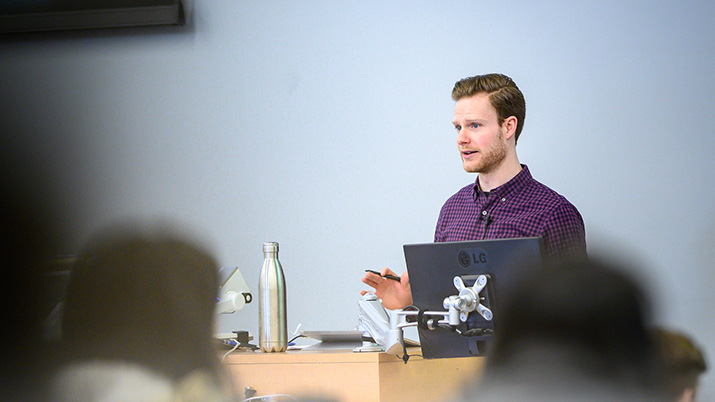



As the new academic year approaches, Arts ISIT welcomed over 100 faculty and staff to the fourth annual Arts ISIT Welcome Back Conference.
Hosted on August 26, 2026, the event brought together instructors, staff, students, and alumni to discuss the evolving role of pedagogy and technology in higher education.


What happens when AI collapses the learning process?

Faculty panelists Dr. Loch Brown (Geography), Dr. Moberley Luger (English), Dr. Rebecca Caruthers Den Hoed (Writing, Research & Discourse Studies) and Dr. Brianne Orr-Álvarez (French, Hispanic & Italian Studies).
The opening panel examined how generative AI is challenging traditional assumptions about assessment and learning. Panelists discussed that AI highlights a longstanding issue: institutions often assess final products rather than the learning process behind them.
To make learning more visible, presenters shared practical approaches for designing assessments. They also emphasized shifting attention from polished outputs to the “messy” work of learning such as reading, annotating, revising, questioning and responding to feedback.
Faculty members also emphasized the importance of critical AI literacy. Beyond technical skills, students need to be able to evaluate AI outputs, recognize limitations and biases, understand ethical implications, and make informed decisions about when and how AI should be used.
💡 Key takeaways for Arts instructors
- Design assessments that capture learning processes, not just final products.
- Incorporate reflective activities, process journals, research notebooks, and scaffolded assignments.
- Create opportunities for peer discussion, collaboration, and revision.
- Help students develop critical AI literacy alongside disciplinary expertise.
- Consider where AI supports learning and where authentic practice remains essential.
Creating inclusive and accessible learning experiences for students

Panelists Nathalie Adriana Funes Serna (UBC student) and Dr. Janet Um (Asian Studies)
This session brought together faculty, staff, and four student panelists to explore how inclusive course design can reduce barriers to learning.
A key theme was that accessibility cannot rely solely on formal accommodations, as many students face challenges such as diagnostic costs, wait times, stigma, documentation requirements, and institutional distrust. Student presenters noted that only about one-third of students who identify as having a disability are registered with the Centre for Accessibility. As such, presenters discussed the value of regularly seeking student feedback and treating students as partners in shaping learning environments.
Faculty also shared practical Universal Design for Learning (UDL) approaches, including interactive transcripts, collaborative annotation, scaffolded assessments, and flexible participation options. The Inclusive Teaching of Writing (ITOW) project further emphasized the value of transparency, accessibility, and student voice in inclusive teaching.
💡 Key takeaways for Arts instructors
- Design courses with accessibility in mind from the outset rather than relying solely on accommodations.
- Gather student feedback throughout the term and communicate how it informs course adjustments.
- Provide flexibility through multiple ways of participating and demonstrating learning.
- Incorporate low-stakes opportunities for revision, experimentation, and growth.
- Use UDL principles to support learners with diverse backgrounds, experiences, and needs.
Session resources
Additional resources
Learning that lasts: Arts alumni panel

Alumni panelists Lillie Adamson (English Literature '26), Jack Brown (Political Science '23), Dafne Kaynak (Geography '24) and Elsa Wyllie-Rahmani (Political Science '05)
The alumni panel discussed how some of the most impactful learning experiences extend far beyond graduation, with perspectives from Arts alumni working in law, technology, consulting, international affairs, and research.
Across diverse careers, experiential learning opportunities such as research projects, student leadership, simulations, co-curricular involvement, and workplace experiences helped them connect academic learning to real-world challenges. Faculty mentorship also left a lasting influence, with alumni recalling professors who inspired new interests, challenged their thinking, and provided support long after graduation.
Arts alumni emphasized that adaptability, communication, collaboration, and critical thinking have been among the most valuable skills in their careers.
💡 Key takeaways for Arts instructors
- Connect classroom learning to real-world applications whenever possible.
- Design assignments that allow students to bring their own interests and creativity into their work, like creating collages and board games.
- Help students understand potential career pathways related to disciplinary knowledge.
- Foster opportunities for mentorship, networking, and experiential learning.
- Recognize that confidence, adaptability, and communication are often as valuable as technical expertise.
Using technology for productivity

Staff panelists Cara Chuang (Arts ISIT), Mia Faircloth (Theatre & Film) and Daniel Pugh (Arts ISIT)
The final session offered practical and responsible approaches for using technology to streamline tasks. Presenters introduced “information optimization” as a way to manage information more effectively, which involved approaches for managing file access, documenting institutional knowledge, reducing redundant content, and creating sustainable processes for collaborating and storing information.
Presenters also outlined responsible AI use at UBC, emphasizing privacy considerations and the distinction between low-risk and high-risk data. Examples showed how AI can assist with tasks such as drafting communications, summarizing meeting notes, organizing data, creating schedules, matching preferences across datasets, and converting documents into online forms.
The session emphasized that AI is most effective when paired with human judgment. While AI can accelerate repetitive tasks, reviewing outputs for accuracy, context, fairness, and equity remains important.
💡 Key takeaways for Arts instructors and staff
- Review access permissions and shared information regularly.
- Store knowledge in shared systems rather than relying on individual memory.
- Use AI to streamline repetitive administrative work such as note-taking, scheduling, and document creation.
- Follow privacy and security guidelines when working with sensitive information.
- Treat AI outputs as drafts that require human review and oversight.
Conference themes
Although the sessions covered a wide range of topics, several larger themes emerged across the day.
Whether discussing AI, writing instruction, language learning, accessibility, or assessment design, presenters emphasized revealing the processes behind learning. Reflection, discussion, iteration, peer feedback, and practice remain essential to learning, rather than the final product alone.
Presenters encouraged creating flexible learning environments that incorporate multiple ways of engaging, participating, and showing understanding.
Students, alumni, and faculty alike highlighted the importance of connections between instructors, peers, mentors, and communities. Learning is strengthened when people feel supported, heard, and connected to others.
Across discussions of AI, career readiness, and accessibility, presenters consistently identified critical thinking, communication, adaptability, collaboration, ethical reasoning, and lifelong learning as enduring strengths of an Arts education.
Whether used in teaching, learning, or administration, technology was presented as a tool for enhancing human capabilities rather than substituting them. Critical judgment, disciplinary expertise, and thoughtful decision-making remain central to the work of faculty, staff, and students.
As we prepare for the academic year, the conference reminded participants of one recurring message across various sessions: learning happens through reflection, practice, relationships, and meaningful engagement.
Thank you to everyone who attended the Arts ISIT Welcome Back Conference. We hope to see you at another one of our events.